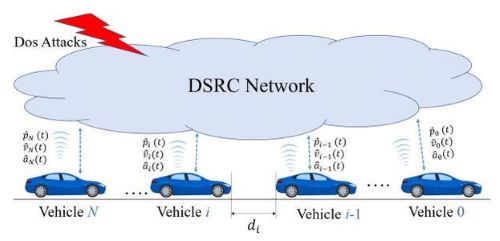
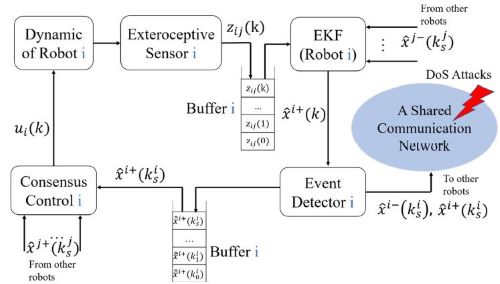
I am currently a Postdoctoral Research Fellow at the Heterogeneous Robotics (HeRo) Research Lab, working with Prof. Ramviyas Parasuraman. I am developing advanced algorithms for multi-robot systems, focusing on resilient cooperative localization, communication-aware coverage, and learning-enabled control strategies for autonomous navigation in dynamic and adversarial environments. My work integrates event-triggered control, model predictive frameworks, and hierarchical decision-making to enhance the robustness, safety, and efficiency of heterogeneous robotic teams.
I received my PhD in Control and Robotic Engineering from the University of Alberta in 2023. During my PhD, I led efforts in the Advanced Control Systems Lab, working on event-triggered cooperative control and localization for multi-robot systems, designing resilient and secure control schemes, and developing real-time algorithms for autonomous navigation and multi-agent coordination.
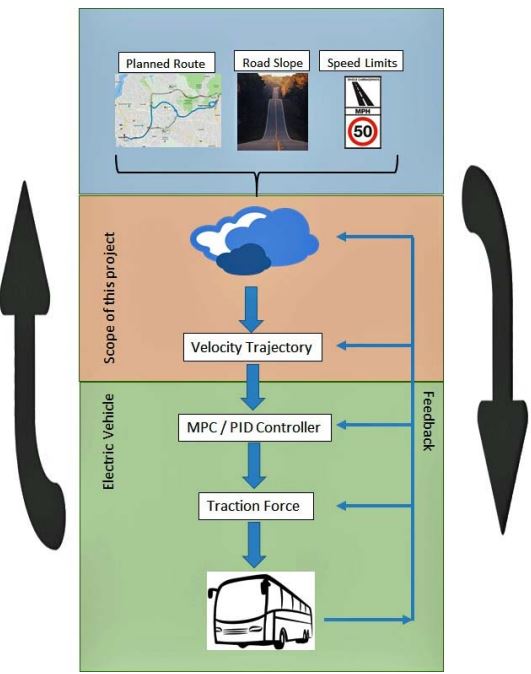
I also worked at General Motors, where I developed algorithms for vehicle dynamics, autonomous driving, and ADAS features, including route optimization, model-based control strategies, and simulation-based testing using MIL, SIL, and HIL environments.
2025 IEEE/RSJ International Conference on Intelligent Robots and Systems (IROS 2025).
IEEE ICRA 2025 Workshop on 25 YEARS OF AERIAL ROBOTICS: CHALLENGES AND OPPORTUNITIES.
[ Paper ]
IEEE Transactions on Automation Science and Engineering.
IEEE Transactions on Industrial Electronics.
Submitted to the 2026 International Conference on Robotics and Automation (ICRA 2026).
[Code ]
Submitted to the 2026 International Conference on Robotics and Automation (ICRA 2026).
[ Code ]
Submitted to the 2026 International Conference on Robotics and Automation (ICRA 2026).
[ Code ]
Submitted to the 2026 International Conference on Robotics and Automation (ICRA 2026).
[ Paper ]
Submitted to the 2026 International Conference on Robotics and Automation (ICRA 2026).
[ Code ]
Submitted to the 2026 International Conference on Robotics and Automation (ICRA 2026).
[ Code ]
IEEE Access
IEEE SMCS Open Source AI-Empowered Human-Machine Teaming (HMT) Competition.
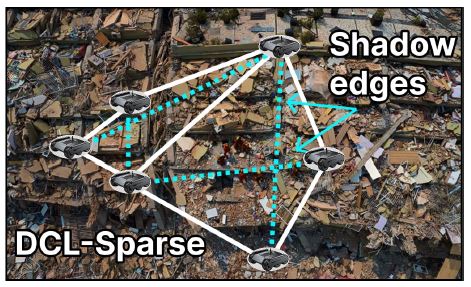
In Search and Rescue missions, robots must operate in cluttered environments with limited sensing and communication. The challenge is to efficiently explore unknown areas while minimizing redundant coverage, ensure reliable and low-latency victim detection, and maintain safe, collision-free navigation with smooth recovery when stuck. Our goal is to design a robust, plug-and-play system that runs in Webots using standard differential-drive robots, enabling scalable deployment in realistic search-and-rescue scenarios. The approach combines cooperative exploration, consensus-based rendezvous, and robust safety control. Each robot maintains a grid map, sharing with teammates to coordinate coverage. Victim detection has the highest priority—robots navigate to the detected victim’s world position or visually track it until depth data is available. Safety mechanisms include short-range braking, mid-field CBF with LiDAR, and stuck detection for autonomous recovery.
Master of science thesis
[ Webpage ]
May 2025